
Taliaferro County Criminal Court Records
A criminal court record is the case file kept by the court after charges are filed or a criminal matter is placed before a judge. In Taliaferro County, the most serious criminal files are Superior Court matters. The official Taliaferro County court-system page lists the local courts that control those records. Magistrate Court is important early in the process because it handles warrants and preliminary hearings. Probate Court may hear traffic violations and certain misdemeanors in counties without a State Court, and Crawfordville Municipal Court handles city ordinance and municipal traffic matters.
The full criminal court record should not be confused with the arrest side of the process. Jail booking records may show personal data, fingerprints, photographs, property intake, and custody status. A criminal court file follows the case in court. It may include the charging document, arraignment, plea, motions, hearing entries, orders, verdict or plea, disposition, sentence, probation terms, and appeal activity. The charge-focused path is treated separately in Taliaferro County arrest records and court charges.
Search Taliaferro County Criminal Records
No official Taliaferro County website was found with a complete public criminal case database. The first search channel is the court office. Superior Court criminal files and felony case records route through the Clerk of Superior Court. Magistrate Court can answer questions about preliminary hearings and warrant matters. Probate Court can answer traffic and misdemeanor questions where it has jurisdiction, and Municipal Court of Crawfordville handles city cases.
- Start with the court level: Superior, Magistrate, Probate, Juvenile, or Municipal.
- Use the defendant name, case number, approximate filing year, charge, or hearing date.
- Ask the clerk whether the case is public, pending, disposed, restricted, sealed, or archived.
- Check Georgia e-access or re:SearchGA only after confirming online participation may apply.
- Request certified copies from the court office that holds the case file when legal proof is needed.
Statewide tools may assist, but they do not replace the Taliaferro County court file. Georgia Courts e-access redirects to provider systems, often with account requirements. re:SearchGA may contain case information and documents for participating counties. GDC offender search, GBI sex-offender registry, and jail records are separate sources and should not be used as substitutes for the court's disposition and sentence.
Taliaferro Criminal Case Flow
The sheriff's criminal-process page gives the clearest local description of how a criminal matter moves. Sheriff Tia M. McWilliams leads the Sheriff's Office, but the court file is maintained by the court once the case opens. An arrest can lead to booking, where personal information, alleged crime, fingerprints, photographs, search, property collection, and jail placement may occur. A preliminary hearing in Magistrate Court tests probable cause. Felony matters may then go to a grand jury, where 23 citizens decide whether to return an indictment, called a true bill, or decline indictment, called a no bill.
Case flow: Charges Filed › Arraignment › Pretrial / Motions › Plea or Trial › Disposition › Sentencing
| Stage | What Happens |
|---|---|
| Preliminary hearing | Magistrate Court decides whether probable cause supports sending the case forward. |
| Grand jury | Felony evidence is reviewed for a true bill or no bill. |
| Arraignment | The defendant is told the charges, advised of rights, and enters a plea. |
| Pretrial / motions | Attorneys file requests, evidence issues are argued, and hearings may be set. |
| Plea or trial | The case resolves by agreement, judge trial, jury trial, dismissal, or other court action. |
| Sentencing | The court orders punishment, probation, fines, restitution, custody, or other conditions after conviction. |
Taliaferro Criminal Process Source
The official Taliaferro County Sheriff's criminal process page is the source for the local process terms used for criminal court records.
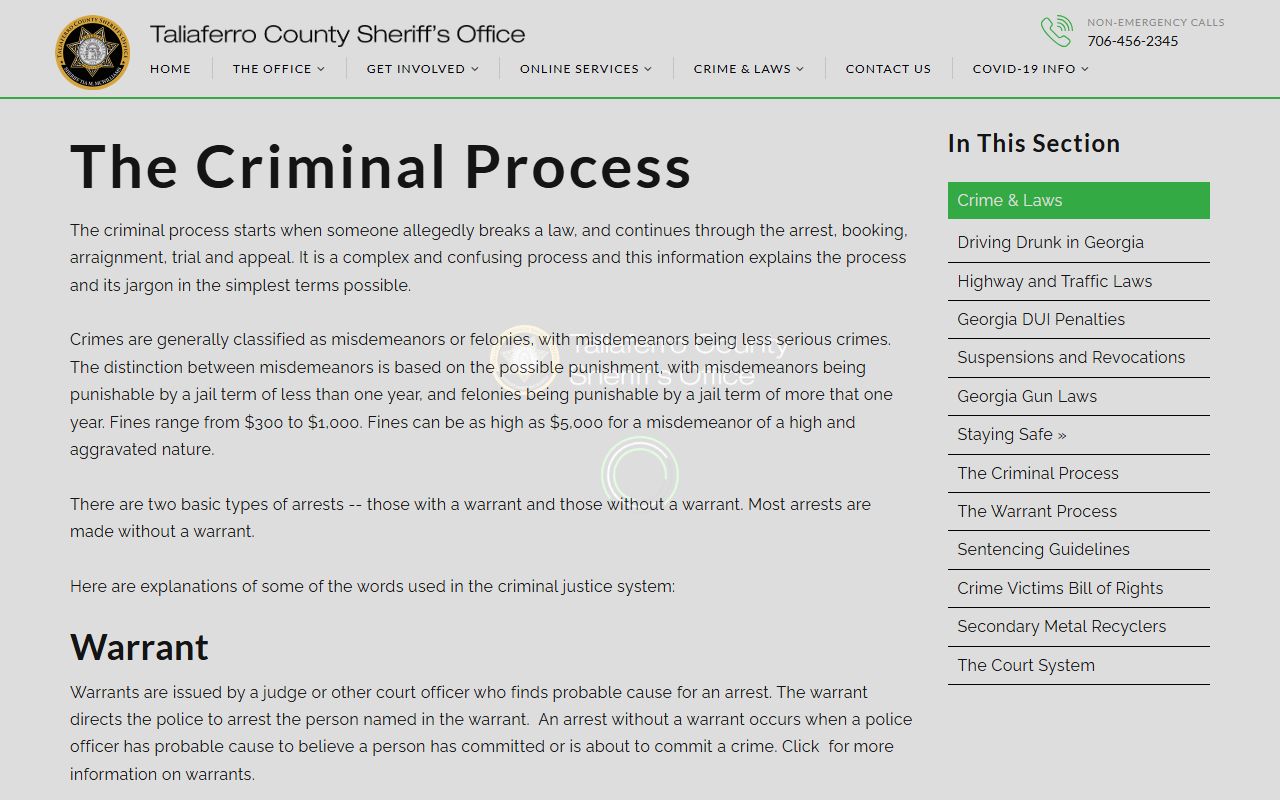
Those local process terms help distinguish arrest, booking, probable cause, arraignment, plea, trial, sentencing, and appeal entries in the court file.
What Taliaferro Criminal Records Show
A Taliaferro County criminal court record can show the difference between an accusation and a final result. It may begin with a warrant, complaint, accusation, indictment, or citation. As the case moves, the docket may show arraignment, bond orders, motions, continuances, plea negotiations, trial settings, jury verdicts, sentencing orders, probation terms, and appeals. For felony prosecution, the District Attorney represents the State of Georgia and attends grand juries as legal advisor.
| Field | What It Shows |
|---|---|
| Case number | The court's identifier for the criminal case or docket. |
| Defendant | The person accused in the court case. |
| Court | Superior, Magistrate, Probate, Municipal, or Juvenile Court depending on case type. |
| Charges | The alleged offenses as filed, indicted, accused, amended, dismissed, or resolved. |
| Bond order | Release terms, bail conditions, or special conditions if ordered by the court. |
| Plea | Guilty, not guilty, nolo/no contest, or later plea changes when shown. |
| Motions and hearings | Defense or prosecution requests, court rulings, and scheduled proceedings. |
| Disposition | The final outcome, such as guilty, not guilty, dismissed, nolle prosequi, acquittal, or other result. |
| Sentence | Custody, probation, fines, restitution, court costs, or other punishment after conviction. |
| Appeal | Review activity by the Georgia Court of Appeals or Supreme Court of Georgia when applicable. |
Toombs Circuit Criminal Prosecution
The sheriff's District Attorney page identifies Taliaferro County as part of the Toombs Judicial Circuit with Glascock, Lincoln, McDuffie, Warren, and Wilkes Counties. It names District Attorney Bill Doupe and states that the DA represents the State in felony prosecution, assists crime victims, attends grand juries, conducts jury trials for cases that do not plead guilty, handles drug forfeiture cases, and handles appeals from Superior and Juvenile Courts.
The Toombs Circuit District Attorney website is the prosecution source tied to Taliaferro County criminal court records.

The prosecutor's role matters because filed charges, plea offers, indictments, dismissals, and trial decisions can change what the court record shows.
Taliaferro Charges vs Convictions
A charge is an allegation. A conviction is a formal finding or plea of guilt. A criminal court record may show charges that were amended, reduced, dismissed, no billed, nolle prossed, resolved by plea, or taken to trial. Reading only the charge line can give the wrong result. The disposition and sentence fields show whether a charge became a conviction and what the court ordered.
| Point | Charge | Conviction |
|---|---|---|
| Meaning | An accusation that a crime was committed. | A guilty plea, guilty verdict, or other formal guilt finding. |
| Record stage | May appear at warrant, accusation, indictment, citation, or arraignment. | Appears after plea, trial verdict, or qualifying court finding. |
| Can change? | Yes. Charges may be amended, reduced, dropped, or no billed. | Yes, but only through later court action, appeal, restriction, or other lawful relief. |
| How to verify | Read the docket and charging document. | Read the disposition, judgment, sentence, and appeal history. |
Reading Dispositions and Sentences
Disposition means the result of a charge or case. In Taliaferro County criminal court records, a disposition may show guilty, not guilty, dismissed, nolle prosequi, no bill, acquittal, dead docket, plea agreement, or sentence. A sentence may include confinement, probation, fines, restitution, court costs, community conditions, or other terms. Some docket entries are short, so certified orders or sentencing sheets may be needed to confirm the exact legal result.
Appeal entries should also be read carefully. The sheriff's process page describes an appeal as a review based on legal error. Appeals from Georgia trial courts may go to the Georgia Court of Appeals or, for categories reserved to it, the Supreme Court of Georgia. An appeal can affect timing, finality, and what records are available from the trial court file.
Sealed vs Restricted Criminal Records
Georgia often uses the term record restriction for criminal-history dissemination limits. The research also refers to sealed records and expungement as common public terms. A restricted history record, a sealed court file, and a redacted document are not the same thing. The correct access rule depends on the agency holding the record and the order or statute that applies.
| Point | Sealed | Restricted |
|---|---|---|
| Main effect | Court access is limited by order or law. | Public criminal-history dissemination is limited for eligible records. |
| Where it matters | Clerk file, docket document, juvenile matter, adoption, or protected filing. | Arresting agency, prosecutor, GBI/GCIC, and related criminal-history sources. |
| Public lookup | May be denied or redacted unless party status or court order allows access. | May not appear in public criminal-history channels after lawful restriction. |
| How to verify | Ask the court clerk what order controls access. | Check O.C.G.A. 35-3-37 and verify with the court, prosecutor, and agency. |
Public Access to Taliaferro Criminal Cases
Georgia's Open Records Act provides broad access to public records unless an exemption, court rule, or order applies. The Governor's Open Records Request page explains that agencies generally respond within three business days and may provide a time and cost estimate when records are not immediately available. For criminal court case files, the court clerk is usually the practical source because the record is part of a court proceeding.
Juvenile records, sealed cases, adoption materials, mental-health details, personal identifiers, and certain restricted criminal-history records are not ordinary public lookup material. Pending investigations and law-enforcement files may also have separate limits. For a public Taliaferro County criminal court record, ask for the case file or docket from the proper court, and ask whether a certified disposition is available if the record is needed for employment, licensing, immigration, or another formal purpose.
Note: Certified criminal dispositions should come from the court clerk, not from a jail, registry, or search summary.
Taliaferro Criminal Record Contacts
Clerk of Superior Court Herberina M. Turner is the main contact for Superior Court criminal case files. Magistrate Court is the source for preliminary hearings and many warrant-related court events. The Sheriff's Office may have arrest, booking, jail, or warrant records, but those are not the same as the final criminal court case file. Official fee amounts for criminal copies or certified copies were not located in county sources, so contact the custodian before mailing payment.
Clerk of Superior Court
113 Monument Street
P.O. Box 182
Crawfordville, GA 30631
706-456-2123
Superior and Juvenile court record office.
Magistrate Court
113 Monument Street
P.O. Box 264
Crawfordville, GA 30631
706-456-2253
Warrants and preliminary hearing questions.
Sheriff's Office
758 Warrenton Road SE
P.O. Box 97
Crawfordville, GA 30631
706-456-2345
Arrest, jail, warrant service, and law-enforcement records.